Sentiment Analysis: A Native Salesforce Solution by Infoglen

An account-level sentiment intelligence model, designed and implemented by Infoglen on Salesforce Data Cloud and Agentforce

Let’s Connect to Read What Your Customers Are Signaling


Infoglen: Our Trusted Partner for AI-Based Customer Sentiment Analysis

Salesforce captures a wealth of customer interaction data, emails, cases, meetings, surveys and conversations. 

However, when teams try to assess overall customer health, that visibility often turns into interpretation rather than clarity.

Teams see activity, sentiment and signals across multiple touchpoints, yet still struggle to form a clear, shared view of the account. Insights remain fragmented, reviews become subjective and early warning signs are easy to miss.

As a result, leadership and customer success teams are left debating questions like:

Is this account actually at risk or just temporarily noisy?

Are recent changes meaningful, or part of normal behavior?

Where should teams intervene first and why?

What’s missing is a consistent way to evaluate customer signals together at the account level.

Infoglen’s Sentiment Analysis extends Salesforce’s native sentiment capabilities by translating multi-domain customer signals into one account-level intelligence score that teams can trust and act on.

Solution Overview

Sentiment Analysis is a custom intelligence layer, designed and implemented by Infoglen, built natively on Salesforce using Data Cloud and Agentforce. This is not a dashboard and not a generic health score. It is a business-aligned sentiment model, designed to reflect how leadership actually evaluates customer health.

What Makes This Different From

Native Salesforce Sentiment

True Account-Level Scoring

Native Salesforce sentiment evaluates individual interactions such as emails, chats, or support cases. Those signals are useful, but they remain isolated and moment-based.

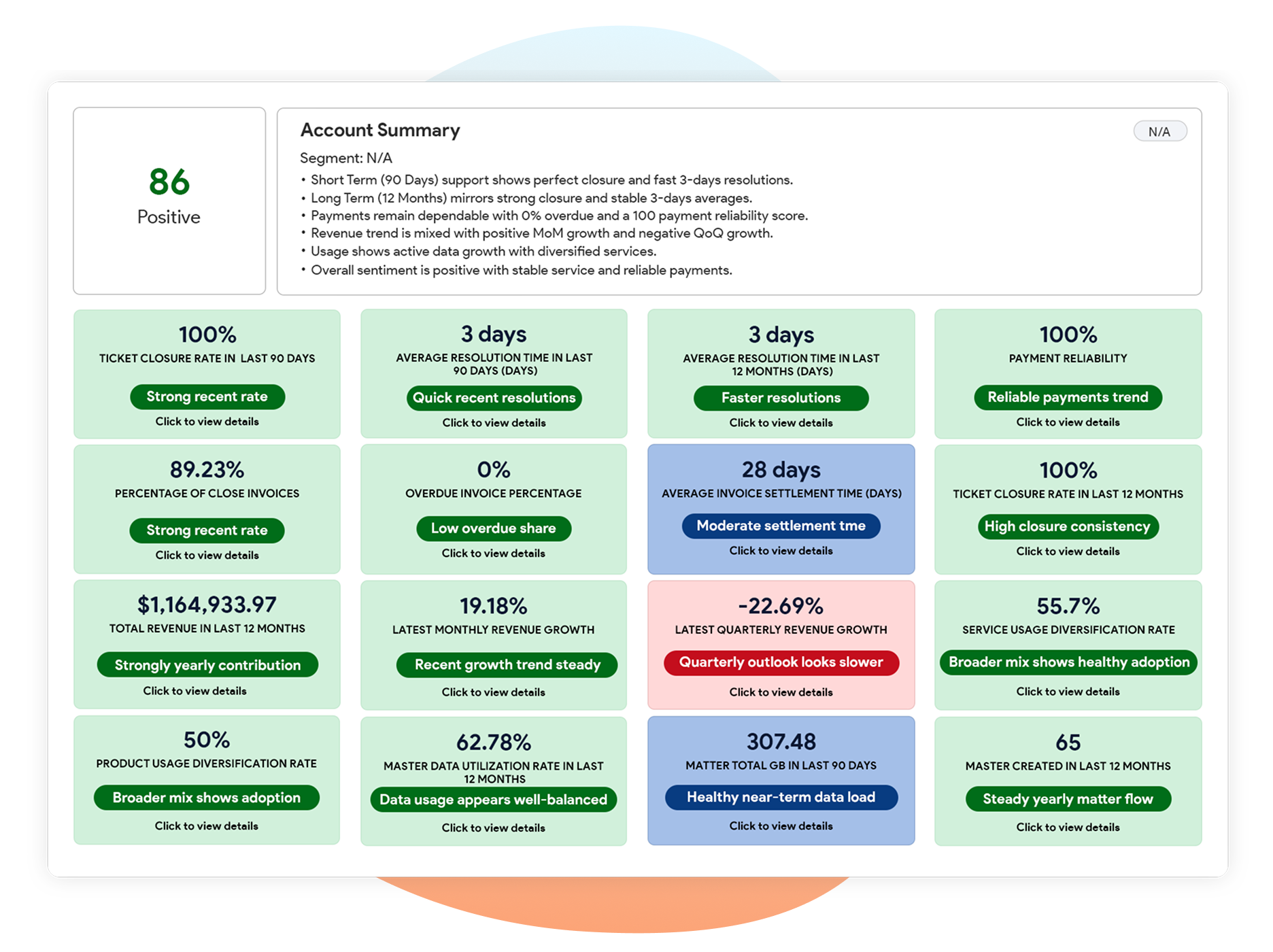
Our solution produces one account-level sentiment score (0–100) by evaluating the relationship as a whole, including:

Communication tone and intent across interactions

Product or platform usage behavior over time

Revenue trends and billing stability

Support activity, SLAs and escalations

NPS and survey feedback

The output reflects account trajectory, not just interaction sentiment, answering a leadership question rather than a reporting one.

Infoglen Sentiment Analysis: UI showing business-aligned weighting for usage, revenue, and service signal groups.

Business-Weighted Intelligence

Native sentiment applies fixed logic. This model applies business-aligned weighting.

Different signal groups (usage, revenue, service, communication, feedback) contribute to the score based on how your organization defines customer risk and success.

Key characteristics include:

Explicit and configurable weightages

No hard-coded assumptions

No one-size-fit-all scoring

Easily configurable within Salesforce without engineering changes

This allows the sentiment logic to evolve as products, GTM strategies, or risk tolerance change.

Explainability Built In

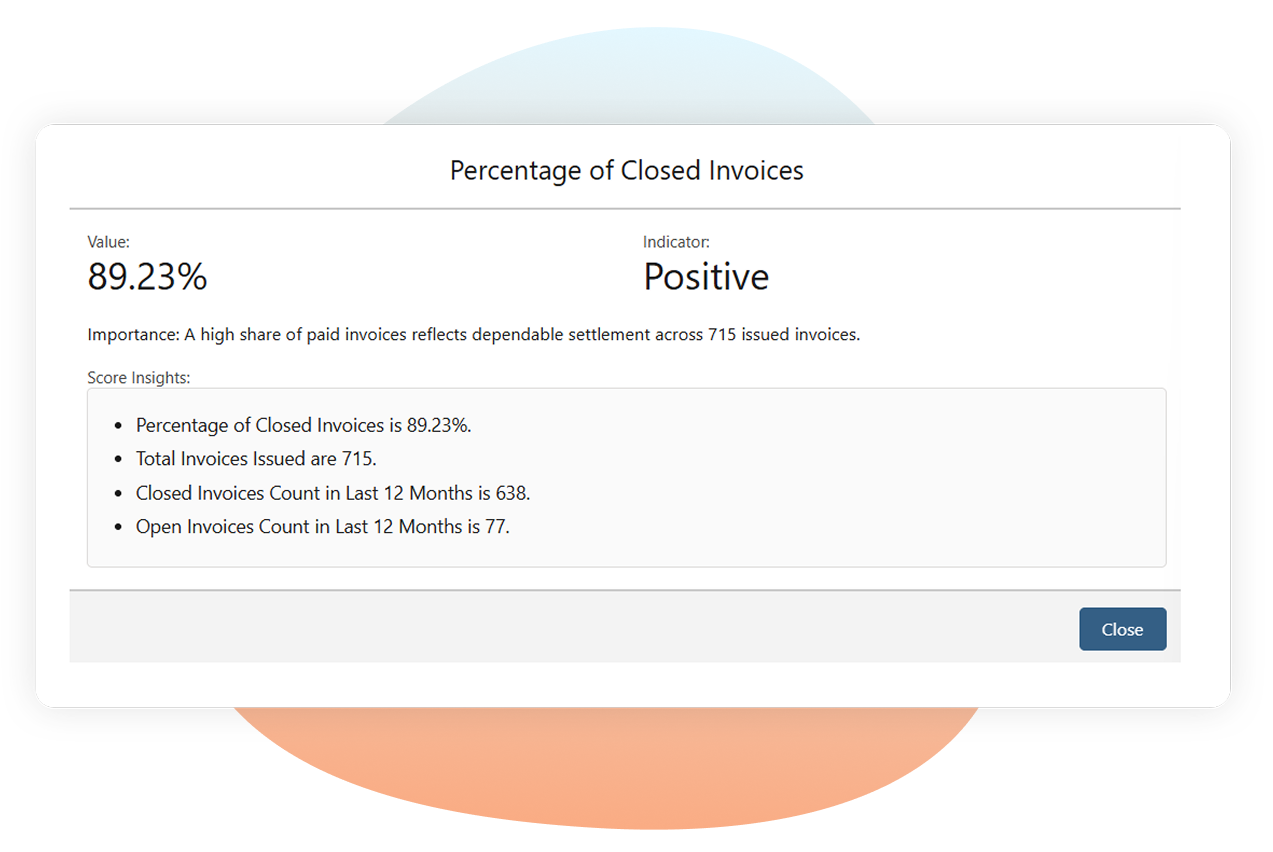
Native sentiment provides labels or scores with limited context. Our Sentiment Analysis solution provides reasoning alongside every score.

Each account sentiment includes:

Clear contributing signal groups

Relative importance of those signals

Plain-language explanations tied to observed behavior

This makes the score usable in account reviews and can be confidently used in leadership discussions, not just operationally informative.

Infoglen Sentiment Analysis: UI showing custom AI scoring and reasoning deployed natively on Salesforce records.

Native Deployment, Custom Intelligence

The model is deployed natively inside Salesforce, but the intelligence logic itself is custom-designed.

Unlike native sentiment features that are fixed in scope and behavior, this approach:

Uses Salesforce Data Cloud and Agentforce as the foundation

Implements custom account-level scoring, weighting and reasoning

Persists scores and explanations directly on Salesforce records

There is no external BI tool, no parallel analytics layer and no context switching, while still delivering capabilities beyond native sentiment features.

Industry-Wise Use Cases

Technology
& SaaS

Financial
Services

Healthcare &
Life Sciences

Manufacturing

Who Is This For

Role We Address

What They Gain

Account Managers / Customer Success Managers

A prioritized account view with clear, explainable sentiment signals to act fast and confidently.

Customer Success & Sales Leaders

Portfolio-level visibility into customer health, with proof that teams are focused on the right renewal risks.

Support Leaders

Clear alignment between support performance (SLAs, escalations) and overall customer sentiment.

RevOps / Analytics

Explainable sentiment data that can be trusted and tied directly to revenue and renewal metrics.

Marketing Ops / Growth

Sentiment-driven signals to time retention, upsell and advocacy campaigns effectively.

Executives / CXOs

A defensible, high-level view of customer health connected to renewals, net revenue retention and business impact.

Our 6-step Implementation:
Sentiment Analysis

Data Unification

Salesforce and external sources (e.g., Snowflake) are unified in Data Cloud to create consolidated account profiles.

Signal Engineering

Quantitative metrics and historical trends are aggregated; communication data is standardized for analysis.

Recency & Trend Modeling

Signals are evaluated over time to capture direction, not just current state.

Build the Predictive Model

Using Salesforce-native tools like Einstein Prediction Builder, Model Builder and Data Cloud, we train models using historical CRM data.

AI Reasoning Layer

Agentforce evaluates signals together, not in isolation, to generate, account sentiment score, key drivers and business-readable reasoning

Explainability Assembly

Scores are packaged with transparent drivers and explanations.

Results You Can Expect
Because We’ve Done It Before

Organizations using our sentiment analysis solution have seen:

15–25%

Lower churn risk by spotting negative sentiment 30–60 days earlier

20–30%

better account prioritization by focusing on declining sentiment, not reactive case volume

25–40%

less manual analysis through automated sentiment scoring

10–15%

higher renewal confidence with timely, context-aware customer conversations

Sentiment Analysis | FAQs

  • Q: How is this different from Salesforce’s native sentiment features?

    Salesforce’s native sentiment evaluates tone at the interaction level. Our solution evaluates sentiment in the context of account behavior by combining interaction sentiment with usage, revenue and support signals. The output is an account-level sentiment score that reflects overall customer health and direction.

  • Q: Is this meant to replace Salesforce health scores or success plans?

    No. It complements existing health scores by adding an AI-driven sentiment layer that captures qualitative signals and early change patterns. This allows teams to identify risk earlier without changing existing workflows.

  • Q: Is this a black-box AI model?

    No. Each sentiment score includes clear contributing factors and business-readable reasoning. Teams can see why a score changed, not just the result, ensuring trust and transparency.

  • Q: How does the model avoid reacting to one-off negative interactions?

    The scoring logic evaluates trends and recency rather than single events. Short-term sentiment spikes are assessed against historical behavior and other reinforcing signals. This reduces false positives caused by isolated incidents.

  • Q: How is AI used in the sentiment scoring process?

    AI is used to interpret unstructured data and reason across multiple signal types. It evaluates signals together rather than in isolation and generates structured explanations alongside the score. This removes the need for manual interpretation of dashboards.

  • Q: Can the sentiment logic be tailored to our business?

    Yes. Signal weightages, thresholds and evaluation windows are configurable within Salesforce. This allows the scoring logic to align with how your organization defines customer risk and success.

  • Q: What data is required to get started?

    The model works with the data you already have in Salesforce and connected systems. This typically includes interaction data, usage metrics, revenue signals and survey feedback. It does not require a fully mature data setup to deliver value.

  • Q: Where are the sentiment scores and explanations visible?

    All outputs are surfaced directly inside Salesforce. Scores and explanations appear on account records, Customer 360 views and executive dashboards. No external analytics or BI tools are required.

  • Q: Who owns the model after implementation?

    You do. The model runs entirely within your Salesforce environment. Configuration, governance and data ownership remain with your team.

See how Sentiment Analysis fits your Salesforce environment

Connect with our experts for a focused walkthrough and a clear view of pricing based on your data, scale and customer health priorities.